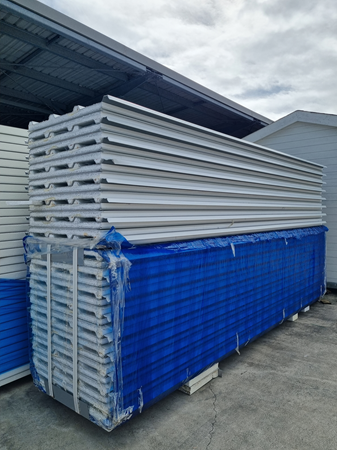
Common and Uncommon Uses for EPS Roof Panels
EPS (Expanded Polystyrene) roof panels are versatile building materials known for their excellent thermal insulation, lightweight design,
and ease of installation. While they are widely used in traditional construction projects, there are also some innovative and less common
applications where EPS roof panels can provide significant benefits. Below, we explore both the common and less common uses for these panels.
Common Uses for EPS Roof Panels
Residential Roofing
EPS roof panels are a popular choice for residential roofing projects due to their energy efficiency and ease of installation. These
panels provide excellent thermal insulation, helping to maintain comfortable indoor temperatures year-round. They are also lightweight,
reducing the overall load on the building's structure, and their Trimdek profile adds a modern, aesthetically pleasing finish.
Commercial and Industrial Buildings
In commercial and industrial settings, EPS roof panels are commonly used for warehouses, factories, and retail spaces. The superior
insulation properties of these panels help to reduce energy costs by minimizing the need for additional heating and cooling systems.
Their durability and resistance to weathering also make them ideal for large-scale commercial roofs.
Cold Storage Facilities
One of the most common uses for EPS roof panels is in the construction of cold storage facilities and refrigerated warehouses.
The high thermal insulation provided by these panels is essential for maintaining the low temperatures required to store perishable
goods such as food, pharmaceuticals, and other temperature-sensitive products.
Patios, Pergolas, and Verandas
EPS roof panels are increasingly being used in outdoor structures like patios, pergolas, and verandas. Their lightweight nature
makes them easy to install, and their insulation properties help to create comfortable shaded areas, protecting against the heat of
the sun. The durable Trimdek profile also ensures long-lasting protection against the elements, making these panels a great choice for
outdoor living spaces.
Less Common and Innovative Uses for EPS Roof Panels
Temporary and Portable Buildings
EPS roof panels are an excellent choice for temporary or portable buildings, such as construction site offices, event spaces, and
temporary classrooms. Their lightweight design allows for easy transport and quick assembly, while their insulation properties ensure
a comfortable interior environment, regardless of external conditions.
Greenhouses and Agricultural Buildings
While traditionally not the first choice for agricultural buildings, EPS roof panels are increasingly being used in greenhouses
and other agricultural structures. Their insulation properties help maintain stable temperatures, promoting plant growth in greenhouses
or protecting livestock in barns. Additionally, these panels can help reduce energy costs by maintaining optimal growing conditions
with minimal reliance on artificial heating or cooling.
Modular Homes and Prefabricated Structures
As the demand for modular and prefabricated homes grows, EPS roof panels are becoming a preferred material due to their lightweight
nature and excellent insulation. These panels can be easily integrated into modular building designs, providing energy efficiency and
quick assembly, which are key factors in the construction of prefabricated structures. This use is particularly popular in remote or
hard-to-reach areas where traditional construction methods are less feasible.
Soundproofing Solutions
Though not their primary purpose, EPS roof panels can also be used in soundproofing applications. Their dense, insulating material
helps to reduce noise transmission, making them suitable for use in buildings near airports, highways, or other noisy environments.
By integrating EPS panels into the roofing structure, builders can enhance the acoustic performance of a building without the need
for additional soundproofing materials.
Renovations and Retrofits
EPS roof panels are increasingly being used in renovation and retrofit projects. Their lightweight and thin profile makes them easy
to install over existing roofs, adding an extra layer of insulation without the need for extensive structural modifications.
This application is particularly useful in older buildings where improving energy efficiency is a priority but maintaining the
existing structure is essential.
In summary, while EPS roof panels are commonly used in residential and commercial roofing, their versatility and range of
benefits also make them suitable for a variety of less common applications. From temporary buildings and greenhouses to
soundproofing and modular homes, EPS roof panels offer innovative solutions for modern construction challenges.